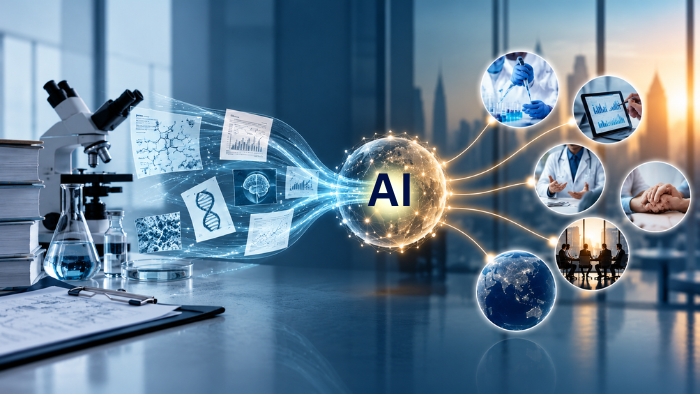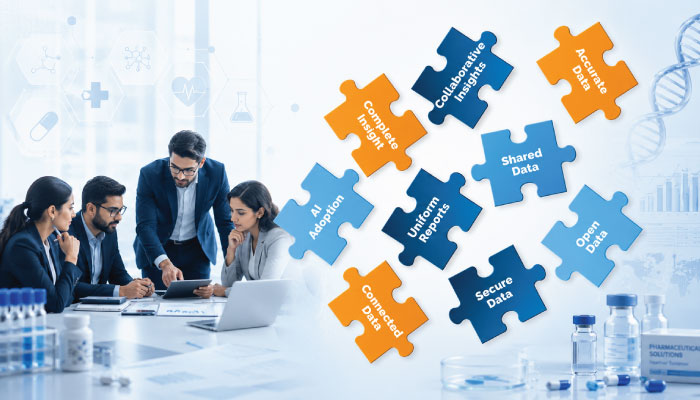
Indian pharma has spent two decades getting exceptionally good at creating content. With Gen AI in the mix now, the industry produces more of it, faster, than ever before.
That is precisely why an old problem has turned urgent. Gen AI does not create knowledge fragmentation — it accelerates it. A decade back, disconnected teams produced disconnected content at a manageable pace, and errors could be caught in time. Today, every function and every agency can generate content at machine speed, and unverified or inconsistent science can multiply faster than any MLR review can keep up with. The result is a second, quieter problem: most of this content now looks and sounds the same — different brands, same tone, same template, same AI cadence. It earns a brief nod of approval and disappears into the noise.
A single brand today may run scientific decks, visual aids, leave-behinds, CME content, KOL videos, WhatsApp communication, emails, patient materials, e-detailing assets, training modules and conference updates — all at once.
The real problem, though, may be the opposite of a content shortage.
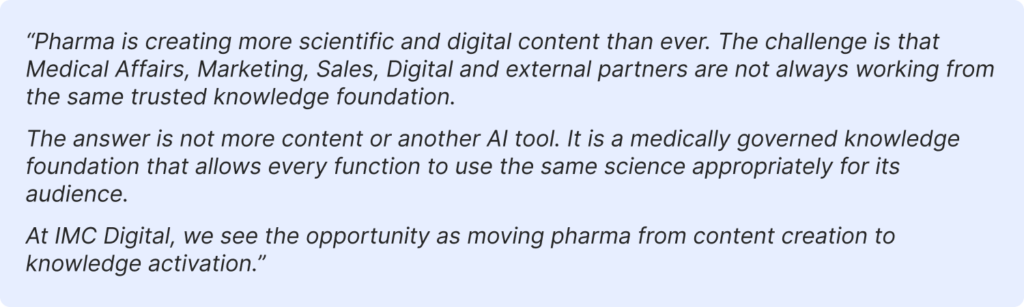 — G. Vishwanand, Founder, IMC Digital
We have more content than ever, but not always one connected, medically accurate source behind it.
Medical Affairs interprets the science. Marketing builds the brand narrative. Training converts it for the field force. Sales brings back insights from doctors. Digital teams adapt messages channel by channel. Multiple external agencies add further assets on top — email, WhatsApp, LinkedIn, Meta, YouTube. Each function does its job well. But when the underlying knowledge does not move seamlessly between them, fragmentation sets in — quietly, one asset at a time.This matters even more in India.
The Indian market still runs on doctor engagement and branded generics, with digital channels complementing the medical representative’s visit rather than replacing it. An Accenture India study found that 84% of HCPs want differentiated experiences, and 94% want at least a third of their pharma interactions to be virtual or digital. The same study also found that channels often remain disconnected, leading to communication that is repetitive at best and irrelevant at worst. Vivek Kamath, then Managing Director of Abbott India, put it well: “Digital engagement has become central in reaching healthcare professionals.” True. But adding more channels without connecting the knowledge behind them does not create more value — it only creates more versions of the same science, each told a little differently.There is a governance angle too.
India’s UCPMP 2024 requires drug information to be balanced, up-to-date, verifiable and capable of substantiation. As channels and content partners multiply, holding scientific consistency together only gets harder, and more critical.So the next phase of pharma transformation is unlikely to be more digital content.
It is a trusted knowledge foundation that every function and partner draws from, instead of each one reconstructing the science on its own.What this looks like in practice
Take one efficacy claim from a Phase III trial for a cardiology brand. Today it typically gets reinterpreted five times over — a scientific deck by Medical Affairs, a leave-behind by Marketing’s agency, a WhatsApp line by the digital team, a training slide by L&D, an e-detailing card by a vendor. Five interpretations, five chances for drift or error, and five separate points where UCPMP substantiation has to be re-checked. In a knowledge-activation model, that claim is captured, MLR-approved and version-controlled once, with its source data, approved language and permissible boundaries attached to it. Every downstream asset is then produced from that single approved version — never reinterpreted from scratch. Update the claim once, and every asset built on it inherits the correction automatically.Most pharma companies already have a repository. Very few have a knowledge graph.
This is the distinction that gets missed. A repository is a well-organised filing cabinet — approved PDFs, decks and claim sheets, searchable and version-stamped. Useful, but still a passive store. Someone still has to find the right file, read it, and rewrite it for their channel — and that is exactly where drift and inconsistency creep back in, even with good governance in place. A knowledge graph works differently. Instead of storing finished documents, it stores the underlying units of science — a claim, the trial data behind it, its approved indication, its contraindications, its permitted audience, its review date — and the relationships between them. A single molecule’s efficacy claim is not one file; it is one node, linked to the data that supports it, the regulatory boundary that constrains it, and every asset ever generated from it. This structural shift is what makes AI genuinely useful here, not merely faster. Once science exists as a graph rather than a document, an AI model does not “write content” — it compiles a permissioned view of the graph for a given audience and channel: a two-line WhatsApp message for a busy HCP, a fuller leave-behind for a KOL conversation, a simplified explainer for a patient, a script for e-detailing. The content strategy sets the rules — who sees what, in how much depth, on which channel, within what regulatory limits. The AI applies those rules against the graph. It does not invent the science; it renders an authorised slice of it. This is what “AI in pharma content” should really mean. Not a tool that writes faster from a blank prompt — that is still one more independent interpretation, just produced by a machine instead of an agency. It is a compiler that turns one governed body of science into every audience-appropriate output the organisation needs, with each output traceable back to the exact node it came from. That is where pharma content needs to go next — not a bigger content library, but a living, structured, auditable map of the science itself, from which everything else is generated on demand.Before briefing the next asset, ask a different question.
Not “What content do we want?” but:What business or knowledge problem are we actually trying to solve?
— G. Vishwanand, Founder, IMC Digital